





Agulhas' Carbon Reduction Plan
Supplier name: Agulhas Applied Knowledge
Publication date: 18th April 2026
Commitment to achieving net zero
Agulhas Applied Knowledge (“Agulhas”) is committed to achieving net zero emissions by 2050.
Baseline Emissions Footprint
Baseline emissions are a record of the greenhouse gases that have been produced in the past and were produced prior to the introduction of any strategies to reduce emissions. Baseline emissions are the reference point against which emissions reduction can be measured.
| Baseline Year: | FY 2023-2024 |
| Additional details relating to the baseline emissions calculations: | |
| Data gathered on the Normative.io calculator specifically designed for small businesses to calculate carbon emissions as part of the SME climate commitments. Endorsed by the Small Business Climate Hub and based on the requirements set out in the GHG Protocol. | |
| Baseline Year Emissions | |
| Emission | TOTAL (tCO2e) |
| Scope 1 | 0 |
| Scope 2 | 6.15 |
| Scope 3 (included sources) | 93.65 |
| Total emissions | 99.8 tCO2e |
Current Emissions Reporting
| Reporting Year: | FY 2024-2025 |
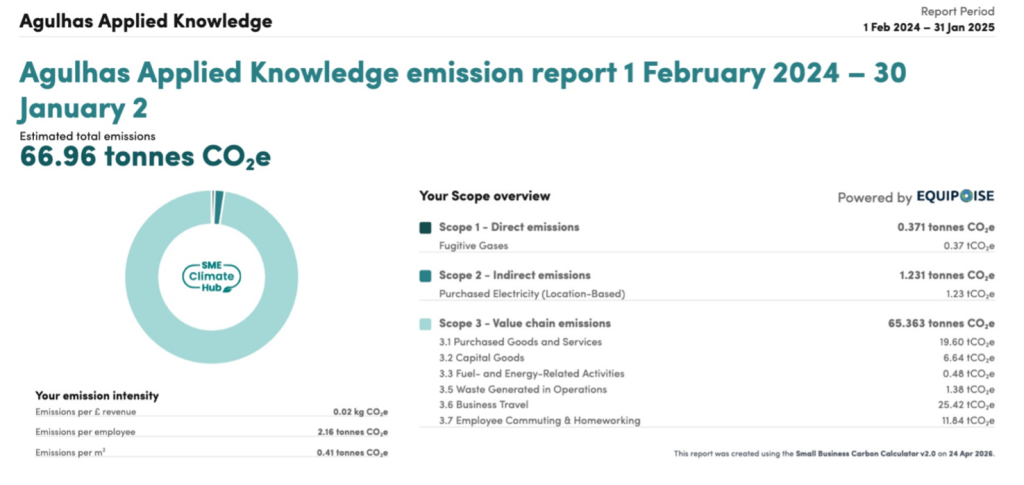
| Data gathered on SME Climate Hub Equipoise carbon calculator specifically designed for small businesses to calculate carbon emissions as part of the SME climate commitments. Endorsed & used by the Small Business Climate Hub and based on the requirements set out in the GHG Protocol. FY 2024/25 is the latest available emissions report. Our reporting cycle is designed around our accounting cycle; as the SME Carbon Calculator requires information based of company financial statements, our carbon calculation cycle is designed around the confirmation and finalisation of our annual accounts.
Not all required data was available during this reporting period. For some required information, such as disposed waste and water, we estimated totals based on calculations that considered our size, office use and general organisational behaviours. |
|
| Emission | TOTAL (tCO2e) |
| Scope 1 | 0.37 |
| Scope 2 | 1.23 |
| Scope 3 (included sources) | 65.36 |
| Total emissions | 66.96 tCO2e |
Emissions Reduction Targets
To continue our progress to achieving net zero, we have set the following carbon reduction targets.
We project that carbon emissions will fall to 58 tCO2e by 2031, representing a 10% reduction over the next five years.
As a small consultancy operating from a single leasehold office, our organisation presents an inherently low-emission baseline.
- We generate close to zero Scope 1 emissions, as we have no owned or controlled combustion sources, company vehicles, or on-site energy generation from fossil fuels.
- Our Scope 2 emissions are minimised through our procurement of 100% renewable electricity, meaning our office energy consumption carries no associated carbon intensity.
- Our hybrid working policy with London-based staff attending the office approximately 40% of the time, further reduces both energy demand, waste products and employee commuting impacts.
As an SME professional services firm, our material emissions profile is necessarily limited in scale; our carbon reduction and management activities are therefore proportionate to the nature, size, and scope of our organisation, in line with the expectations set out under PPN 006. This means that we project a similar level of carbon emissions year on year, notwithstanding required travel from client delivery work. We remain committed to continuous improvement and transparent reporting as our carbon management practice matures.
Scope 3 Emissions: Business Travel and Aviation
Our baseline carbon assessment identifies business travel, specifically international client flights, as the most significant source of emissions. This reflects the nature of our global development evaluation and research work, which often requires in-person engagement across diverse global regions where a physical presence is either expected by clients or operationally necessary. In 2024/25, we were required to conduct fewer in-person assignments that required international flights, and this contributed to our significantly reduced Scope 3 emissions compared to 2023/24.
While we are committed to maximising the use of virtual collaboration tools and remote engagement wherever practicable, we recognise that digital solutions are not themselves carbon-neutral, carrying their own environmental footprint through the energy and water consumption of data centres and supporting digital infrastructure. Substituting travel with virtual working therefore represents a reduction in emissions rather than their elimination.
Furthermore, not all client interactions can be conducted remotely without material impact on the quality of our service delivery, research ethics considerations or client relationships. International travel therefore remains an operational necessity in a proportion of our project work.
It is also acknowledged that aviation-related emissions represent an area in which our organisation has limited direct influence. The decarbonisation of the aviation sector, including the development and scaling of sustainable aviation fuels and lower-emission aircraft, is driven by industry investment, regulatory frameworks, and technological progress that fall outside the control or influence of individual SMEs. Our ability to reduce the carbon intensity of the flights we do take is therefore constrained by factors beyond our operational remit.
Carbon Reduction Projects
Completed Carbon Reduction Initiatives
The following environmental management measures and projects have been completed or implemented since the 2023/24 baseline. The carbon emission reduction achieved by these schemes equates to 110 tCO2e, a 110% reduction against the 2023/24 baseline. The measures will remain in place throughout delivery of the contract.
Carbon mitigation initiatives
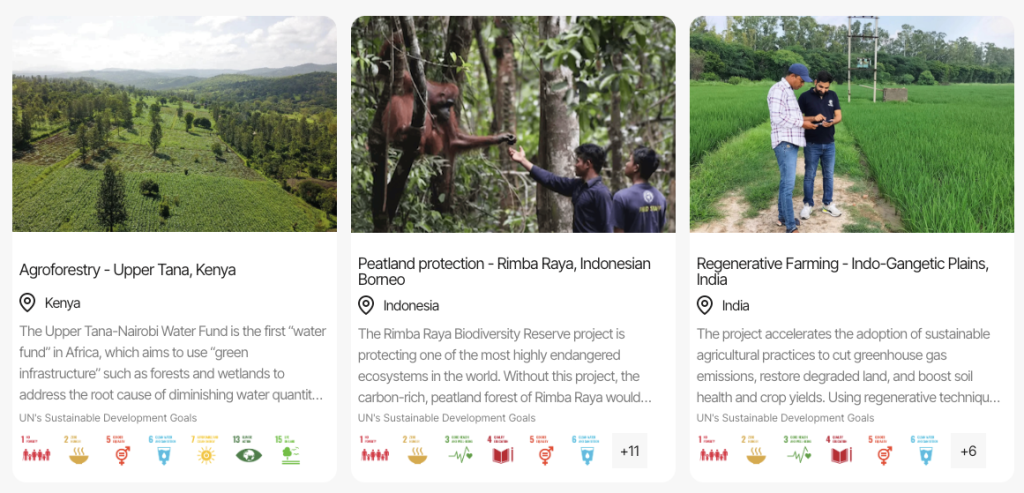
To mitigate against unavoidable emissions, particularly those arising from international business travel, we have partnered with Earthly, a platform that enables organisations to invest in verified, nature-based solutions that deliver carbon sequestration, biodiversity restoration, and community benefits. In FY 2023/24, we funded the following projects. This equated to 110 Tonnes Co2 sequestered, 10% more than our carbon emissions in the financial year.
Future Carbon Reduction Initiatives
In the future we hope to implement further measures such as:
- Carbon mitigation: Continuing our partnership with Earthly, in 2026 we will look to invest further in nature-based solutions to mitigate against our 2024/25 impact, and in 2027, we will mitigate against our 2025/26 impact. This cycle is designed around our accounting cycle; as the SME Carbon Calculator requires information based of company financial statements, our carbon calculation cycle is designed around the confirmation and finalisation of our annual accounts.
- Mindful catering choices: From 2026, Agulhas will adopt a plant-forward catering policy for all internally organised meetings, training sessions, and events where food is provided. By eliminating meat and reducing dairy from our catered functions, we aim to reduce the embodied carbon associated with our organisational activities. We recognise that livestock agriculture is a significant contributor to greenhouse gas emissions. Whilst modest in scale, and difficult to quantitively record, this commitment reflects our broader ethos that responsible environmental stewardship extends to all aspects of how we operate as an organisation.
- We actively encourage staff to bring home-prepared lunches to the office, reducing reliance on pre-packaged meals and the associated single-use packaging waste. This initiative supports both our carbon reduction goals and our broader commitment to minimising operational waste, recognising that individually small behavioural changes can have a meaningful cumulative impact across the organisation over time.
We acknowledge, however, that these initiatives are difficult to quantify with precision. While waste falls within the scope of the GHG Protocol-compliant SME Carbon Calculator, the methodology requires waste to be measured by weight. This is something that is not practicable to monitor on a regular basis within our operational context. The carbon impact of catering choices similarly falls outside the boundaries of our current calculation framework. As a result, these actions are best understood as behavioural and cultural commitments rather than measurable reduction targets.
This is an important distinction in the context of our overall carbon management approach: because our ability to accurately measure certain emission sources is constrained by the limitations of available SME-appropriate tools, our primary carbon management strategy centres on mitigation against measured emissions through our partnership with Earthly, rather than relying on reduction activities that cannot be robustly evidenced. We believe this approach is both transparent and proportionate for an organisation of our size and nature.
* The language in this Carbon Reduction Plan was developed by Agulhas and refined with the assistance of an AI writing tool to improve clarity, consistency and professional presentation. All content reflects the organisation’s own activities, commitments and operational context. AI was used solely to tighten and articulate the text, not to generate or substitute organisational thinking.
Declaration and Sign Off
This Carbon Reduction Plan has been completed in accordance with PPN 006 and associated guidance and reporting standard for Carbon Reduction Plans.
Emissions have been reported and recorded in accordance with the published reporting standard for Carbon Reduction Plans and the GHG Reporting Protocol corporate standard and uses the appropriate government emission conversion factors for greenhouse gas company reporting.
Scope 1 and Scope 2 emissions have been reported in accordance with SECR requirements (where required), and the required subset of Scope 3 emissions have been reported in accordance with the published reporting standard for Carbon Reduction Plans and the Corporate Value Chain (Scope 3) Standard.
This Carbon Reduction Plan has been reviewed and signed off by Nigel Thornton, Founder and Director, on behalf of the board of directors.